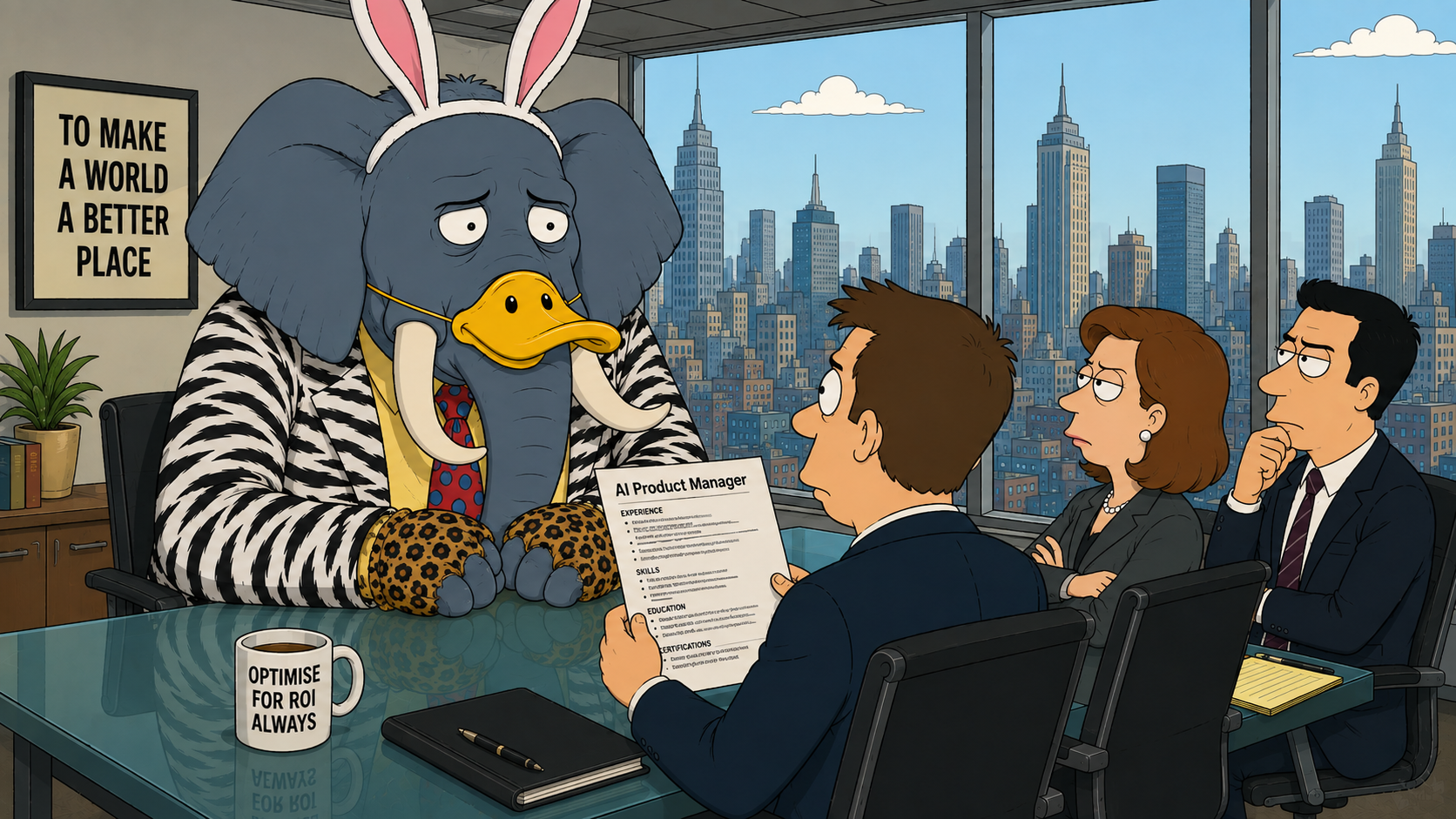
Since agentic workflows are the new standard for modern product engineering, and to some extent for product design, I've seen an interesting phenomenon happening around Product Management role expectations in the job market lately.
Job descriptions for classic PM roles have changed in the last year or so. Product sense is still the core function required, so discovery, prioritisation, customer understanding, business outcomes and strategy are taken for granted, which makes sense. Although there are new requirements that might look desirable, in many cases they are the new bar for applicants: years of experience building AI products, LLMs, RAGs and evals, agents and context engineering, at least one programming language, full-stack web development familiarity, design taste, business acumen and domain expertise, to name some that seem to surface as a pattern.
Some months ago, I still saw posts on LinkedIn asking if Product Managers should know how to code or prototype, so today, it seems to be the new standard. As a hiring manager, all these requirements make sense for a new team member who is expected to raise the bar and lead a product, but I wonder to what extent it is realistic. I mean both finding that person and, if found, whether all these skills and capabilities will be used in the role as envisioned.
Different sources say AI PM roles have surged between 30-120% YoY. It is quite evident if you run a query in your favourite job platform that there are more Product roles opening with a slight variation: AI PM.
So, what are the implications of adding AI to the title? Hmm, it is worth pointing out that companies looking for these roles span from startups or scaleups that developed AI-native products, but also corporations or well-established companies that look to add AI capabilities to their actual product proposition so it can compete in their domains and keep innovating.
For a classic Product Manager, it is still expected that you excel in discovery, prioritisation, stakeholder management, business outcomes, among others. But there it is, a new factor: AI fluency as an umbrella that will try to gather several competencies similar to a digital skills Swiss army knife equivalent. Because for a PM it is not enough to write a good prompt to generate an image or a PPT. It is key to understand the technology to gain a competitive edge and be resolutive, a self-starter to save time, to confirm a hypothesis, to share a vision, or to start gathering feedback with a lo-fi product, even before consuming design or engineering resources for a proper product evolution. That is where the new bar is: technical agency on top of any other core skill you previously had.
Well, does that mean domain expertise is less needed in Product roles? Absolutely not. Actually, this is what will make an AI PM generate value in the shortest amount of time, basically finding the perfect candidate, as their product and business skills with a good amount of technical agency are the transferable competencies which most of the JDs aim, or should aim, to cross in their wishlist.
So, to be pragmatic, would you hire someone who has domain expertise but little exposure to product or technical agency? That is quite common. Many executives from different departments within a company, say Operations, Finance, HR, Marketing or Sales, switch careers to be more into the techie side within Product. They also have an onboarding curve, but they know the product from the other side, as a client or as the customer voice. Think the other way around: someone who is very technical, knows all the technicalities of the product, architecture, technologies used, features, bottlenecks and possible error sources. When they get into product, they need to talk to customers, many of them, because even for a product that is technically sound, they know that there is a functionality they could add because it is there. “I would use it,” they say, but not all customers are that technical, not even products for technical profiles in many cases.
What makes a good AI PM then?
That depends on the problem you are trying to solve. The complexity of it. The urgency to solve it. The budget you have. The available talent offer within your domain. A great PM in Finance might not be the best if then hired for Ad-tech products, but they could be a good fit for HR products, though not as good as someone who was already feeling the pain of the problem they are trying to solve.
As a recruiter, how to model this? If some of the keywords do not match, I might be rejecting a good PM with technical agency but no experience, or hiring technical profiles that worked with AI products for years as Architects or delivery leads but might not be as effective when it comes to realising what is needed to make an AI product adopted.
It is tough, isn’t it?
I’ll try to sum it up in a 4-step framework:
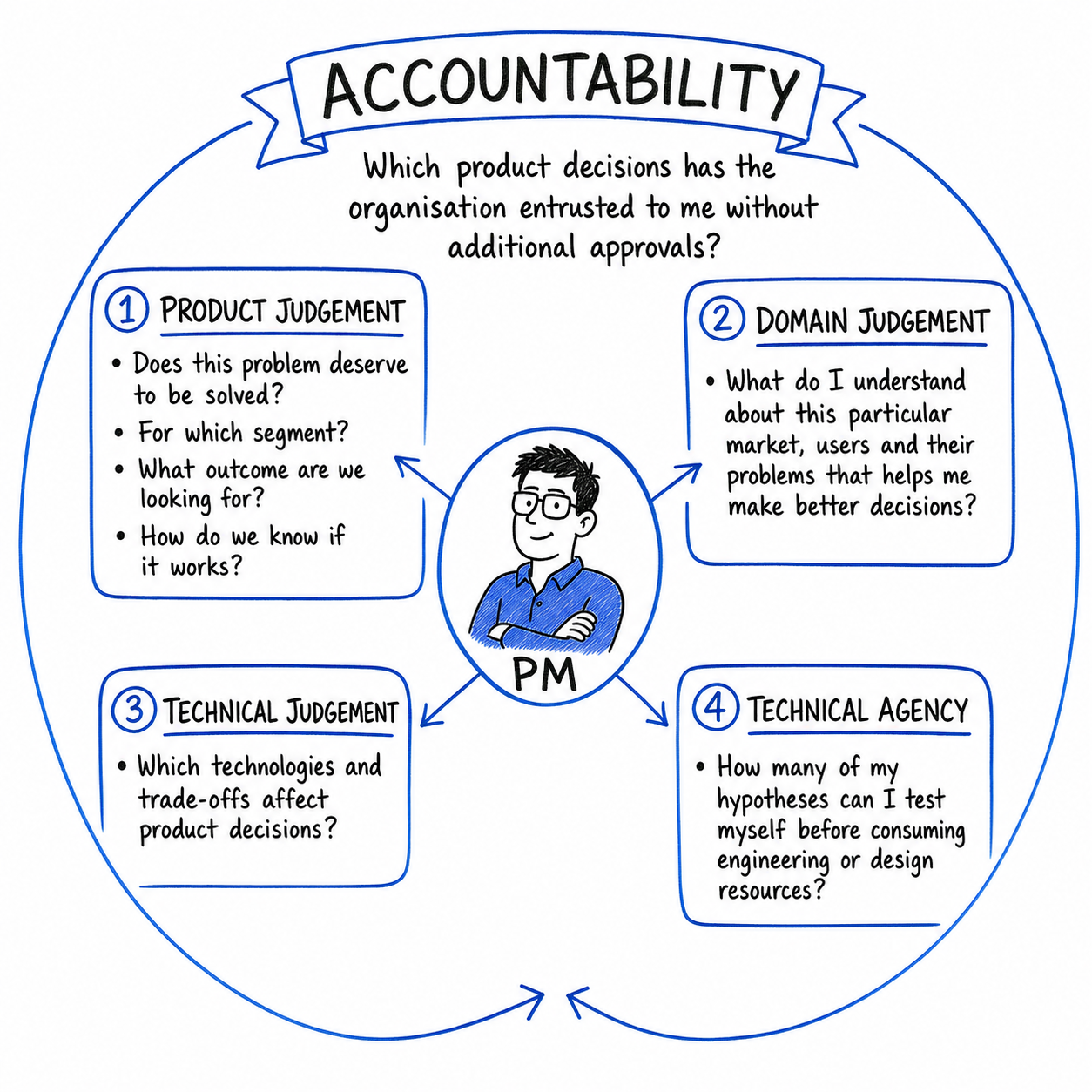
Product sense
Are we solving the right problem? Are we aiming at the right segment, is the outcome clear, are we able to track it?
Domain expertise
What do you understand about this particular market that changes the product decision? Do I know the users, typical workflows, regulations, economics, competitors and constraints?
Technical judgment
Which technological realities should change the product decision? I am not expected to become another designer or engineer, but I need to know how to leverage the technology to propose the needed trade-offs to keep moving forward. This is massively impacted by AI these days.
Technical Agency
How far can I test my assumptions before asking for design or engineering capacity? This is massively transformed by AI tools like Codex, Claude, Cursor and similar.
That is it. The first two were the classical PM, the other two what actually is changing due to AI. Is that all? Not really.
If we had unlimited budget, probably we would buy a Ferrari, or your favourite car, even to pick up a brick of milk from the nearest shop. It would be nice, but it is overkill. The same could be happening if we do not take into account the level of accountability and responsibility expected from this new hire. As a hiring manager, if you know your organisation is highly hierarchical or political, and in practice, the decision layer will be above the pay grade of your new AI PM, then it is a bad hire. They will opt out, look for another job or, even worse, silently resign by not caring enough about their products.
Next time you want to write a job description, just bear this in mind.
Instead of going through a process like skills -> JD -> candidates -> interview -> hire.
Ask yourself these questions.
- What outcomes will this person own?
- Will he or she have the resources needed to succeed?
- Which decisions can they make without escalated approval?
- Which domain knowledge is genuinely required on day one or day 90?
- Which technical trade-offs must they understand?
- What should they be able to test independently?
You might end up with a process that looks more like accountability -> decisions -> required judgement -> required agency -> candidate profile.
This will help to draw these eliminatory questions.
- Do I require Python or an AI certification for an AI PM role?
- As a Legal AI company, should I insist on five years in Legal Tech?
- Can I accept candidates from different industries?
- Is it needed for my product to have someone with strong design taste and tech-savviness?
Maybe the perfect candidate for your role is really possible. Maybe it is us, as hiring managers, that did not realise which kind of AI PM we actually needed.